Showing posts with label Interviews. Show all posts

Monday, December 10, 2012

Occupy Prose: Will Johnson in conversation with Linda Svendsen

Linda Svendsen's story, "Restoration," was published in The Fiddlehead's Essential West Coast Poetry and Fiction issue, #253. One of her UBC Master's in Creative Writing students, Will Johnson, interviewed her for our blog.


Linda Svendsen
"Restoration" is the story of a refugee from Burundi who is struggling to adjust to Canadian culture after surviving some horrific experiences in her home country. What inspired you to tackle this subject, and what sort of research did you have to do?

A decade ago, my husband and I co-produced and co-wrote a 6-hour miniseries for CBC called Human Cargo. It’s a drama, not a documentary. We’d spent a few years researching the Immigration and Refugee Board in Canada, attending hearings, and had also traveled to Kenya, Tanzania, and South Africa. We’d also done a fair amount of reading/interviewing of people who have survived torture, extreme loss, and exile.

You've developed a very distinctive voice for your main character. Did you find it hard, as a Canadian, to imagine an inner life for this character? Did you find it challenging to see things from her perspective?

Monday, November 26, 2012

Witnessing Both the Ugliness and the Beauty: Will Johnson in Conversation with Chris Donahoe

Chris Donahoe, photo by Will Johnson
Chris Donahoe's creative nonfiction story, "Test," appears in The Malahat Review's Essential East Coast Writing issue, Fall 2012 #180. Will Johnson recently graduated from UVic's creative writing program and is now finishing an MFA at UBC. His first major publication was "Sea to Sky," in The Fiddlehead. He now lives in Halifax, NS.

Your story "Test" (Fall, 2012, issue #180) is about your time working in Alberta’s oil industry right after graduating from high school. What drew you to this story?

In my class with Wayne Grady last year, we tried to look a little deeper at the stories we tell over and over throughout our lives. You know, the stories we tell over beers, or as ice-breakers, or to girls/guys we want to sleep with. These stories become our go-to material in certain situations when we want to impress someone or give them a sense of who we are. And, each time we tell a particular story, it becomes something more fixed and polished, something that comes to define who we think we are and where we think we came from. As a creative nonfiction writer, it’s interesting, and important, to step back sometimes and think about why we tell those stories when we do, and to try to uncover any patterns or bits that link them all. This process can be incredibly revealing and scary, depending on the content. The final event in my story is, quite literally, awesome, a thing that I think anybody would turn into a story to tell over a beer. It’s been bubbling inside me for a long time. But when I put it next to the other stories I tell, it takes on another life and I see that there were other things compelling me to tell and write this story other than the incredible nature of the event itself. The story’s about unexpectedly finding amazing, beautiful things when everything looks most wrong and ugly. That’s a trend for me, not only in my stories, but in my life in general.

Monday, November 5, 2012

The Fiddlehead's Interview with Joan Clark

I recently had the opportunity to sit down with acclaimed Canadian author and current University of New Brunswick writer-in-residence Joan Clark. Our discussion moved from her early career in Alberta up to her novel-in-progress (which is set in Sussex, NB) and the state of Canadian publishing.

Joan Clark is a Member of the Order of Canada and the author of two short story collections, four novels, six novels for younger readers, and three picture books. She lives in St. John’s, Newfoundland.

- Kyle Connelly, Editorial Assistant


(Right Click or Control Click on the above link to download mp3 interview.)

Sunday, November 4, 2012

A Lot of us Leave and Lots of us Come Back: Will Johnson in Conversation with Kris Bertin

Kris Bertin
Kris Bertin's first major publication was "Girl on the Fire Escape" in The Malahat Review (Winter, 2011 #173). His second Malahat publication, "Your #1 Killer & Extra Hands," appears in our Essential East Coast Writing issue, Fall 2012 #180.

Will Johnson recently graduated from UVic's creative writing program and is now finishing an MFA at UBC. His first major publication was "Sea to Sky," in The Fiddlehead. He now lives in the apartment Kris Bertin formerly occupied in Halifax, NS.

Your story was published in The Malahat Review’s Essential East Coast Writing Issue, which is a joint venture between The Malahat Review and The Fiddlehead, celebrating the differences and similarities between the artists from these regions. How much of a role does geography play in your work?

I’d say it plays a huge role. There’s always a decision about where a story takes place, and even if it isn’t explicitly stated, it’s important to know as a writer. “Your #1 Killer and Extra Hands” never tells the reader that it takes place on PEI, but from its conception I always knew it would. Having this story published in this issue is particularly appropriate—[main character] Chris Rose’s story took him from a small town in the Maritimes to Great Big Toronto, then Montreal, and back to PEI. While he didn’t make it all the way to the west coast, it tells us something about being an East Coaster, which is that a lot of us try very hard to get the hell out of here and find work somewhere else.

Friday, November 2, 2012

Where to Buy Magazines in Halifax? Atlantic News!

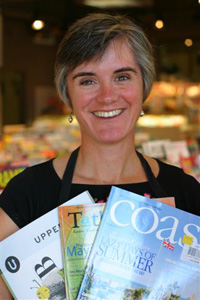
Malahat volunteer, Heike Lettrari, asked Michele, Owner and Manager of Atlantic News, a proud carrier of The Malahat Review, a few questions about the store.

Michele, Owner of Atlantic News

What's the literary sensibility like in Halifax? Is there openness for other Canadian, American, and International writing, or is there favouritism for local authors, poets, and writing projects?

Halifax loves to read and write. We have the Writers Federation of Nova Scotia, Poet Laureate Tanya Davis, a number of reading series, Word on the Street, and tons of book launches and signings. There are many local writers and poets that get published in a variety of literary journals.

Wednesday, October 31, 2012

Snag a Bystander with a Hook: Jay Ruzesky's Bicoastal Conversation with Bill Gaston and Mark Anthony Jarman

Bill Gaston
Bill Gaston came to the University of Victoria's Writing Department in 1998 following a dozen years in the Maritimes, mostly at UNB, in Fredericton. There he was Director of the Creative Writing Program, and, for a time, editor of Canada's oldest literary journal, The Fiddlehead.

Mark Anthony Jarman
Mark Anthony Jarman is a graduate of The Iowa Writers' Workshop, a Yaddo fellow, has taught at the University of Victoria, the Banff Centre for the Arts, and now teaches at the University of New Brunswick, where he is fiction editor of The Fiddlehead.


As I remember it, Mark, you were a sessional instructor at UVic and left to take a position at UNB in 1998, and Bill, you were a sessional at UNB and left to take a position at UVic in 1998 so you switched east for west and west for east. Have I got that right? Do you feel at home where you are now?

Friday, October 26, 2012

A Poetics of Decolonization

An Interview with Tim Lilburn
By Shane Rhodes

The following is a conversation between Shane Rhodes and Tim Lilburn about Lilburn’s recently published, Assiniboia, and Rhodes’ work in progress, X. The conversation took place over a few weeks this summer and was conducted by email.

Shane Rhodes: Assiniboia is built on an argument that the colonization of the land on which we live in Canada is not only a process of the past but an ongoing process that invades and engenders the present of our settler society, our relationship to land, our relationship to First Nations, our relationships to each other, and even our poetics. What you seem to be proposing in Assiniboia (and propose is almost too weak of a word for your insistence) is a different way of thinking about the past, the present, and colonization. What is some of the thinking that made you want to attempt Assiniboia? Why now?

Tim Lilburn: The Harper government is proposing a model of this country that places Western Canada’s resource wealth, especially tar sands oil, at its centre. I, along with many others, am uncomfortable with an understanding of the West that is built entirely on an extractive, and environmentally irresponsible and dangerous, approach to wealth — the snatch it and leave strategy, decamping to England or a gated community on Vancouver Island — the old Hudson Bay Company, Rupert’s Land model, the new big oil model. I would like an alternative way of imagining where I live.

Wednesday, October 24, 2012

Nothing Too Small to Say: Anita Lahey in Conversation with M. Travis Lane

M. Travis Lane
Millicent Travis Lane lives on a quiet street “up the hill” in Fredericton, New Brunswick, across the street from the campus of the University of New Brunswick, where she has been an honorary research associate since 1967. A PhD graduate of Cornell University, where she marked for Vladimir Nabokov and wrote her dissertation on agnosticism as technique in the work of Robert Frost, Lane has published fourteen volumes of poetry plus several chapbooks, and has been reviewing poetry for The Fiddlehead since the late sixties. She’s a recipient of the Pat Lowther Memorial Award, the Atlantic Poetry Prize, the Alden Nowlan Prize for Literary Excellence, the Bliss Carman Prize, and several other awards. We spoke in her living room on a mild May evening, amid her enchanting collection of art and bric-a-brac, and two very sociable cats. (We continued our conversation via email afterward, and parts of this further exchange are incorporated below)

Sunday, October 21, 2012

Like the Star-Nosed Mole: John Barton in Conversation with Mary Dalton on Her Cento Variations


Mary Dalton
Malahat editor John Barton interviews St. John’s poet Mary Dalton about her contemporary use of the cento, an ancient poetic form. Three of Mary’s centos, “Netted,” “Appliqué,” and “Invitation Cards” are a highlight of Essential East Coast Writing, The Malahat Review’s Autumn 2012 issue. A list of the source texts she drew from to assemble these poems is found on the Malahat website.

Can you define what a cento is classically and then explain how you’ve modified the rules—or broken them—and for what purpose?

In writing seminars I’ve told my students that you don’t work in a form by accident, yet in a sense that’s what happened with me and the cento. I had made several of these collage pieces before I learned that I was working variations on a form that had ancient antecedents.